The Patch Nobody Mows: Tracing the Paper Trail Behind a Neglected Plot
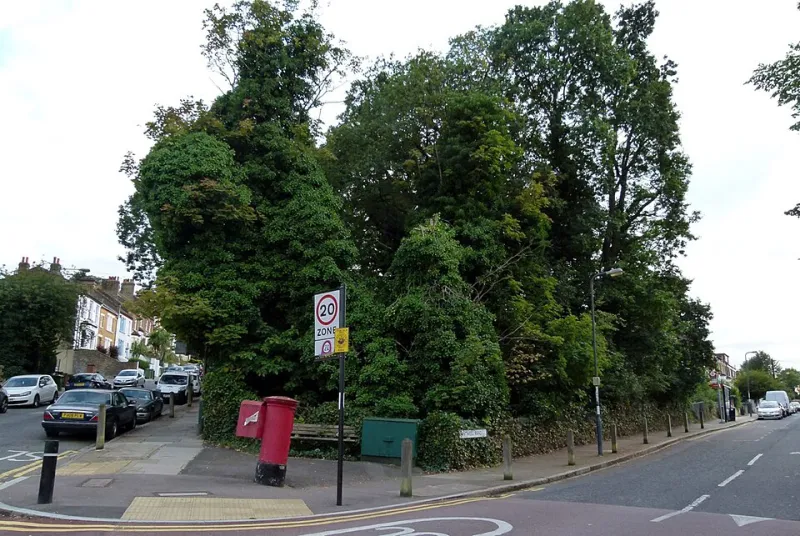
Photo: Kleon3, CC BY-SA 4.0, via Wikimedia Commons
Every neighbourhood has one. A wedge of grass behind the garages, a fenced-off strip between two gardens, the corner where the hedge has gone feral and somebody once dumped a mattress. Nobody mows it. Nobody admits to owning it. And then, one morning, there's a surveyor's spray mark on the tarmac and everyone suddenly wants to know who's in charge.
Good news: you can usually find out. Not always quickly, and not always for free, but the paper trail is more open than most people assume. Here's how to follow it.
Start with what the council already knows
Before you spend a penny, look at the planning history. Most councils run a public planning register you can search by address or by a map. Type in the nearest postcode and you'll often find applications relating to the plot going back decades — a lapsed permission for a garage, an old change of use, a boundary dispute that left a paper trace.
Two things are worth pulling from that history. First, whether the land has ever had a lawful use established. Second, who was named as applicant and landowner. Planning applications require a certificate of ownership, so the name on an old form is a lead, even if it's thirty years stale.
While you're on the council's website, hunt for the property asset list or land and property register — sometimes filed under 'transparency' or 'corporate property'. If the plot is council-owned, even by accident, it should appear. Councils are also obliged to publish information about land they hold as open space, so a scrappy bit of amenity grass may show up there.
The seven-quid answer: Land Registry
In England and Wales, most land is registered. Go to the Land Registry's online service, put in the address or drop a pin on the map, and buy the title register. At the time of writing it costs a few pounds — less than a takeaway — and it tells you the registered owner, the title number, whether it's freehold or leasehold, and any charges or covenants noted against it.
You can also buy the title plan, which shows the boundary. Do buy it. Boundaries on the ground and boundaries on a plan are frequently two different stories, and the plan is the version that counts in an argument.
A word of caution about names. The registered proprietor may be a company that was dissolved in 2011, a developer with a mailing address in another county, or the residue of a family estate. A name is not the same as someone who can be found or made to act. That said, a dissolved company is often the most useful finding of all — it explains twenty years of silence.
If nothing comes up, the land may be unregistered. That doesn't mean ownerless. It means ownership rests on old deeds, and you'll need to ask the Land Registry about a search of the index map, and probably take advice.
Public bodies have to answer — up to a point
If the council won't volunteer the information, ask formally. A request under the Freedom of Information Act or the Environmental Information Regulations can get you records about ownership, maintenance responsibility, and any internal correspondence about the site. Keep it narrow: 'all records held relating to the maintenance and ownership of the land at [location] between [date] and [date]' works far better than a broad grumble.
Environmental Information Regulations are often the better route for land questions, because they cover more ground and the exemptions are tighter. Councils have twenty working days, and they do respond — usually.
Your ward councillor is also worth a message. They can't magic up a deed, but they can ask officers directly, and a question raised in public gets a written answer that stays on the record.
The status question matters as much as the owner
Ownership is only half the story. What the land is legally often constrains what can be done with it, whoever holds the title.
- Village green. If local people have used the plot for sport or recreation, openly and without permission, for at least twenty years, it may be registrable as a town or village green. That status is a powerful protection. Evidence matters: photographs, statements from long-standing residents, records of events. Registration is a formal application to the council, and it's not a quick fix.
- Public open space. Land held for public recreation carries its own protections, and disposing of it usually requires a statutory process and often public notice.
- Highways. A strip may be part of the public highway even if it looks like a verge. The definitive map and statement, held by the county or unitary authority, is the record. Ask for the extract covering your area.
- Tree preservation orders and conservation areas. Check the council's mapping before anyone reaches for a chainsaw.
- Contaminated land and drainage. Old industrial plots carry records. Worth a look if the ground has a history.
Flagging it before the sale goes through
Once you know the owner and the status, you have options — and they're all more effective before contracts exchange than after.
Report the site to the council's planning enforcement team if there's unauthorised activity, fly-tipping or a breach of conditions. Ask for the plot to be considered as an Asset of Community Value if it's used for community benefit; that buys a moratorium if it's ever put up for sale. Push for the green registration if the evidence is there. And if the land is council-owned and neglected, put the maintenance question in writing and ask for it to be answered at a public meeting.
What you can't do is force a private owner to tidy up simply because the plot is ugly. Untidiness is not, on its own, a planning matter. Nuisance, pest control and highway safety are different questions with different routes.
The point of all this
The scruffy corner looks like a gap in the system. It rarely is. It's usually a piece of paper somewhere — a title, a plan, a minute, a lapsed permission — and the people who find that paper early tend to be the ones whose streets don't change without them noticing.
Start with the planning register. Buy the title. Ask the council in writing. Then tell your neighbours what you found, because a plot with five informed residents watching it is a great deal harder to sell quietly than one nobody has ever asked about.