Who Actually Put Their Hand Up? Finding Your Councillor's Vote When Nobody Wrote It Down
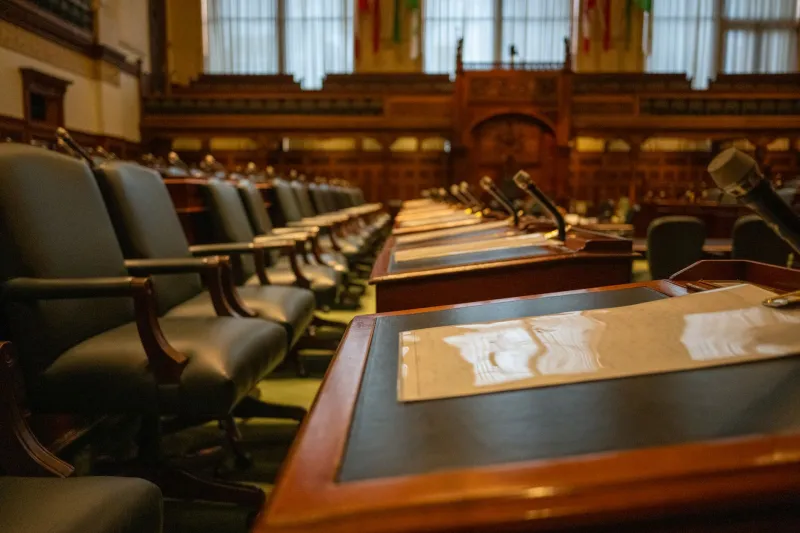
You go to the council meeting. You watch the debate. You see the budget amendment go through, or the parking charge waved away, or the planning objection voted down. And then you get home, open the minutes three weeks later, and find a single bland line: "RESOLVED: that the recommendation be approved." No names. No clue whether your own councillor was in the room, let alone which way they leaned.
This is not a conspiracy. It's just how most councils in England work. Decisions are taken by a show of hands, the clerk counts, and the minute records the outcome. If you want to know who voted for what, you usually have to go looking — and sometimes the answer simply isn't there to find.
Why the record is so thin
Council minutes exist to prove a decision was taken properly, not to publish a league table of who said what. The law and the council's own standing orders generally require the minute to capture the resolution, the mover and seconder, and any declared interests. Individual votes only appear if someone asks for them to be counted and named.
At full council, there is a mechanism for this. Standing orders at most principal authorities allow a set number of members — commonly five — to call for a recorded vote before the question is put. The budget and council tax setting debate is a special case: under the standing orders regulations that apply in England, those votes must be recorded. So if you want to see your councillor's fingerprints on a council tax rise, the budget meeting is usually your best bet.
In committees, the rules vary. Some allow a named vote on request; some leave it to the chair's discretion; some just don't bother. Parish and town councils are a patchwork, and many simply never record individual votes at all.
Reading the clues in the papers
Start with the agenda pack, not the minutes. It will tell you what was decided and, crucially, whether the item was contentious enough to attract an amendment. Amendments are where the interesting splits show up, and a well-run committee will usually note who moved and seconded them.
Then check whether your council publishes a webcast. Most larger authorities now stream meetings and keep the archive online for six months or a year. You can scrub to the vote itself and watch the hands go up, though be warned: the camera angle is often fixed on the chair, and a forest of raised arms at the back of the room is not always easy to read. It's still evidence, even if it's the televisual equivalent of squinting.
Some councils also publish a 'decision notice' or 'record of decisions' shortly after the meeting. These are more useful than minutes for spotting dissent, because they sometimes list dissenters or abstentions. Look for phrases like 'the vote was carried by eight votes to three' — and then check whether the names appear anywhere else in the pack.
When the trail stops short
Here's the awkward truth: if no recorded vote was taken, there is no official document that says how your councillor voted. A freedom of information request won't conjure one up, because the council doesn't hold it. You can ask, of course, but the answer will be a polite version of 'we don't record that'.
So what do you do with a decision that left no fingerprints?
- Ask the councillor directly. A short, specific email — 'On item 7, the parking charges, did you vote for or against, and why?' — is harder to dodge than a general complaint. Most councillors will answer, even if the answer is 'I abstained'.
- Check their own declarations. Many councillors publish ward reports, newsletters or social media posts after a big vote. These are not minutes, but they are on the record.
- Look at the group whip. If the decision split along party lines, the group's public statements will tell you where the party stood. That doesn't prove how your councillor voted, but it narrows the field.
- Turn up next time and ask for a recorded vote. You can't call for one yourself as a member of the public, but you can ask a sympathetic councillor in advance to do it. A five-minute conversation before the meeting is often more effective than a speech afterwards.
The long game: making the record better
If your council never records votes and the idea bothers you, that's a legitimate thing to raise. Some authorities have changed their standing orders to require recorded votes on certain classes of decision — planning applications that go against officer advice, for example, or anything involving a budget cut to a named service. Others publish a searchable 'voting record' page for full council.
You can raise it at public question time, in a letter to your ward councillor, or through a local campaign group. The response will probably be that recording every vote would be expensive and slow the meeting down. That's a fair point, and it's worth debating on its merits. But the principle — that residents can see how their representative voted on the things that affect them — is not unreasonable, and it's the sort of thing that quietly improves trust when councils get it right.
In the meantime, keep your expectations realistic. The minutes will tell you what happened. The webcast will sometimes show you who did it. And your councillor, if you ask them plainly, will usually tell you the rest. It's not a perfect system, but it's the one we've got — and it's a lot better than guessing.